FDA review delays weight drug despite fast-track status

Jan 20, 2026
By Kyle Umipig, Jan 20, 2026 | From: Longevity.Technology
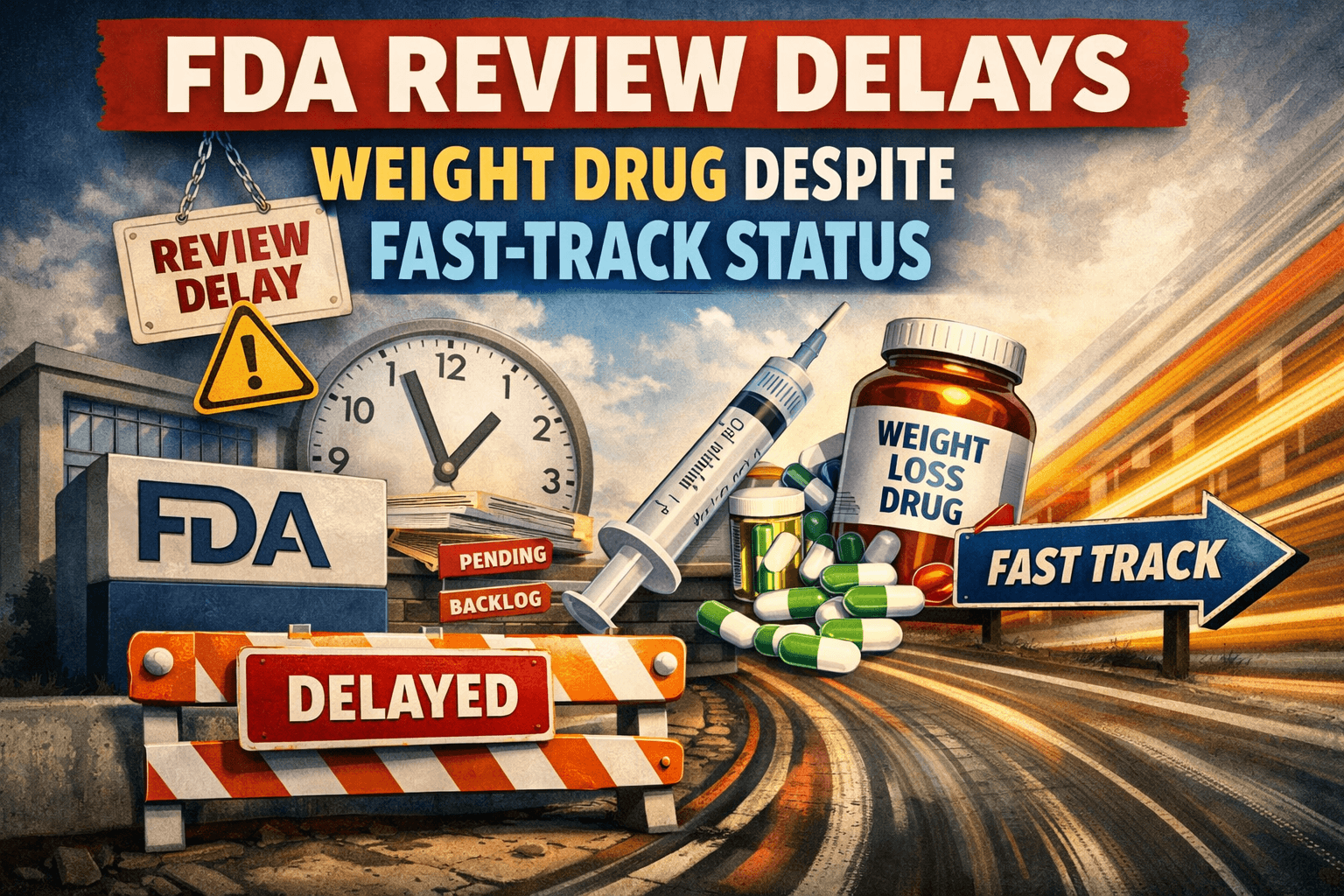
The FDA’s newest experiment in faster drug approvals is meeting an early reality check. Eli Lilly’s once-daily oral weight-loss drug orforglipron – one of the first medicines tapped for the agency’s Commissioner’s National Priority Voucher (CNPV) program – is now facing a delayed decision, despite the program’s promise of near-immediate review.
That delay matters for more than one reason. Oral weight-loss drugs are shaping up to be one of the industry’s most competitive frontiers, with rivals racing to offer GLP-1 medicines that are easier to take, easier to scale and potentially easier to stick with long term. In that context, the difference between “late March” and “April” is not just a calendar change; it’s a signal about how much certainty regulators want before opening the gates.
Last year, the FDA unveiled the CNPV pilot, positioning it as a way to slash approval timelines for drugs aimed at major national health priorities. Instead of the usual review process that can stretch across many months – or longer – the voucher pathway suggested decisions could be reached within a month or two.
On paper, the concept looked straightforward: identify high-need medicines, compress bureaucracy, move faster. In practice, the first wave of voucher-linked reviews is showing that speed has limits, especially when the questions are clinical rather than administrative.
A competitive moment for oral GLP-1s
Orforglipron, a small-molecule oral GLP-1 receptor agonist designed to help manage weight, was expected to receive FDA approval in late March. That target date has now slipped into April.
The timing is awkward for Lilly because the market has started moving beneath its feet. Novo Nordisk’s oral Wegovy reached the US market at the end of 2025, raising the stakes for any competitor hoping to arrive quickly with an alternative.
Regulators, however, appear to be taking their time. According to reports citing internal FDA discussions, the agency is giving closer scrutiny to both orforglipron’s effectiveness and its safety profile before reaching a decision.
That caution may frustrate investors and commercial teams, but it is also predictable. Obesity medicines are poised for enormous population-level reach; even a small shift in risk matters when millions of people are potential candidates. “Fast-track” in this category does not mean “light-touch.”
Priority status still meets hard questions
Orforglipron is not the only voucher-linked drug now facing a longer wait. Sanofi’s Tzield, an immunotherapy already approved in the US to delay the onset of stage 3 type 1 diabetes in certain high-risk patients, has also seen its expanded-use plans slowed. Reports citing internal FDA documents point to a treatment-related death and other safety signals under review, though Sanofi has said no causal link has been confirmed.
The delays extend beyond metabolic and immunotherapy drugs. Disc Medicine’s bitopertin, aimed at rare blood disorders including erythropoietic protoporphyria and X-linked protoporphyria, has also been pushed back. Boehringer Ingelheim’s zongertinib – a targeted therapy for HER2-mutated lung cancer – has likewise been caught up in the shifting timelines, with a decision date reported as moving to mid-February.
Taken together, the pattern is hard to ignore. The CNPV pilot may be designed to compress reviews, but it is not bypassing the kinds of questions regulators are expected to ask: does the drug work; do the endpoints prove it; and what happens when real-world risk surfaces in the middle of a “priority” timeline.
Speed is not the same as certainty
At first glance, these slips might look like simple setbacks for the FDA’s fast-review ambitions. A more realistic interpretation is that the program is running into the same trade-offs that shape every accelerated pathway: time can be shortened, but uncertainty cannot be wished away.
For healthspan-focused medicine, this tension will only become more visible. Many of the interventions most likely to reshape preventive healthcare – obesity drugs, cardiometabolic treatments, therapies intended for earlier use in disease course – are being positioned for broad populations. That changes the tolerance for ambiguity. When the candidate patient is not desperately ill, the bar for safety and clearly demonstrated benefit tends to rise, not fall.
In other words, the next era of medicine will not be decided by speed alone; it will be decided by whether the evidence is strong enough to support scale.
Type something …
Search
Latest Post
The FDA turned down 2 earlier applications
Aug 6, 2026